How Recurring Ancillary Revenue Increases the Value of Your Self-Storage Facility

Here's a hypothetical scenario to consider: two self-storage facilities sit on the same road, with roughly the same size, similar unit mix, and comparable net operating income, but when the owners go to sell, one commands a higher price than the other.
What's going on?
In this article, we’ll explore why recurring ancillary revenue can be the difference-maker when it comes to facility valuation.
Recapping the valuation calculus for self-storage facilities
Valuation is determined not only by how much net operating income a facility yields, but also by the quality of the NOI as indicated by the stability versus the risk of the revenue stream.
More stability and less risk earn a lower cap rate and higher valuation. Likewise, less stability and more risk have the opposite effect.
By far the biggest component of NOI is rental income, so it is to be expected that operators are very focused on achieving high, stable occupancy rates to drive income and a higher valuation.
But occupancy and rental income rise and fall with economic conditions and competitors down the street.
That's why astute operators have come to understand that there is another way to increase the stability and reduce the risk of their NOI revenue to earn a higher valuation:
Add ancillary income from new services, many driven by digital platforms that make implementation and scaling easy.
Ancillary income from recurring service revenue is insulated from the forces that buffet the self-storage industry - and buyers, appraisers, and lenders notice.
With ancillary income, your valuation increases in two ways:
The incremental revenue grows your NOI. Our Ancillary Advantage whitepaper finds that ancillary income can add 7% to 10% to a property's total income.
Your NOI is more stable and less risky, so your cap rate goes down.
So, how does that play out when it comes to your sale price?
Every dollar of NOI carries about $15 of value
Self-storage facilities sell on a multiple of net operating income. Divide your annual NOI by the market cap rate, and you have the value of the asset.

You collect the fee this month, then you keep the value it created.
Cap rates vary by market and asset class.
A Class A facility in a strong metro may trade under 6%, driving value up, while a Class C facility in a more rural area may trade above 7%, driving value down.
The principle holds at any rate, though: recurring income converts into equity at a multiple, while a one-time sale converts into nothing beyond the sale itself.
That's the difference between selling a tenant a $15 lock and selling that same tenant a $12 monthly subscription: the lock earns $15, but the subscription earns $144 a year, and at a 6.5% cap rate, it also adds around $2,200 to the value of the property.
Buyers pay more for income that survives a rate war
An extra $50,000 of NOI from rent and an extra $50,000 from ancillary services look identical on a financial statement.
But the reality is that investors and appraisers don't necessarily value them equally, due to differences in the quality of revenue that falls to NOI.
Here's the hidden opportunity: when risk to the revenue stream is reduced, so is the cap rate, pushing the valuation higher.
In our whitepaper, The Ancillary Advantage, industry consultant RK Kliebenstein makes the case that recurring, high-margin, low-labor revenue is often viewed as more stable and scalable than rental income.
That's because it's less susceptible to street-rate compression, and new digital platforms provide turnkey implementation that scales easily.
A facility built on that kind of income mix is less exposed to rental-rate volatility and more attractive to sophisticated buyers and lenders. The dollar amount on the page is the same. The character of the income behind it is not.
Even a small reduction in the cap rate impacts value significantly.
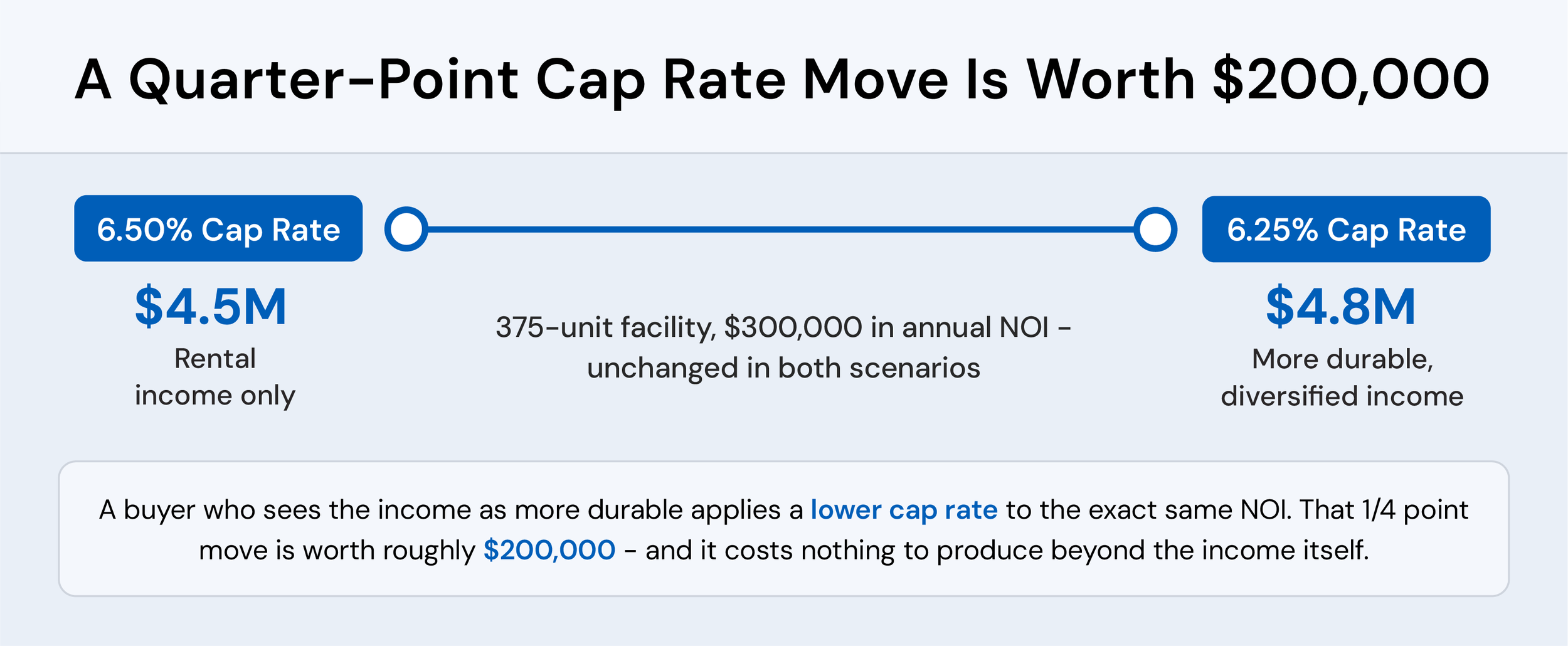
Cap rate treatment ultimately depends on the buyer, the market, and how well-documented your ancillary income is at the time of sale.
The improvement in the rate is an argument you make to a buyer, and you make it with a track record rather than a projection.
Digital mailboxes are a great way to get started
Any operator who staffs the front office during normal business hours can offer digital mailbox service. It's a great way to get more productivity from your front office by utilizing labor downtime. There's no setup fee or capital expenditure, training and onboarding are included, and it takes little time and little space.
Your address is listed on iPostal1.com.
When people choose your address, you get a new customer, whether for business or personal use.
You receive their mail and manage it with an app that makes it easy to process customer requests for forwarding, scanning, discarding or pickup.
You store mail in a file cabinet that requires less than three square feet of floor space. It takes only about 30 minutes of staff time a day per 100 customers to run the service.

We handle the marketing, sign up the customers, and manage the transactions. Our customer service team responds to any customer complaints.
You get a scalable, turnkey program that generates recurring monthly revenue with minimal time and hassle.
Build a stack of ancillary services to compound the valuation benefit
Adding other ancillary income services will not only increase your NOI, but make it less risky – the two levers that drive higher valuation. Small, recurring monthly fees from subscription services add up, especially if you add a stack of several new services.
The whitepaper's central recommendation is to treat these as a portfolio rather than a menu.
Start with an internal audit of underutilized assets, including office floor space, parking stalls, large vacant units, and staff downtime, then stack multiple streams over those assets to build a diversified and resilient income portfolio rather than a single ancillary line item.
You may want to focus on your front office by adding retail kiosks or package services, along with digital mailboxes. If you have unused land available, consider truck parking. By adding smart units, you can capture incremental revenue from premium upgrades.
For the sophisticated owner, these programs are not side hustles. They are, in the whitepaper's words, deliberate, underwritten components of the business plan that can move NOI and valuation in a meaningful way without adding complexity proportional to the dollars generated.
Learn about 10 new ancillary income opportunities in our white paper, The Ancillary Advantage.
Your lender reads the same NOI that your buyer will
Valuation isn't only an exit conversation. The same NOI that sets your sale price is what a lender underwrites.
The whitepaper makes the point directly: a diversified, high-margin income mix that is less exposed to rental-rate volatility is more attractive to sophisticated buyers and lenders alike.
The equity you build through ancillary income is working for you long before you ever list the property.
Ancillary income only counts if a buyer can see it
Whatever ancillary income streams you choose, be sure to document it properly from day one.
This often gets overlooked.
Keep ancillary income as its own line rather than folding it into miscellaneous revenue. Track it monthly, hold onto the customer counts and retention figures, including how long annual-plan customers stay compared to monthly ones, and be ready to show that the income survives a change in ownership.
A revenue stream you can prove is worth considerably more than one you have to explain.
To learn more about the streams covered here and how each one pays, download The Ancillary Advantage, a free white paper on unique revenue streams for self-storage operators.
If you are ready to start building recurring revenue into your self-storage business, contact us today.