What ancillary income products are the best fit for your self-storage facility?
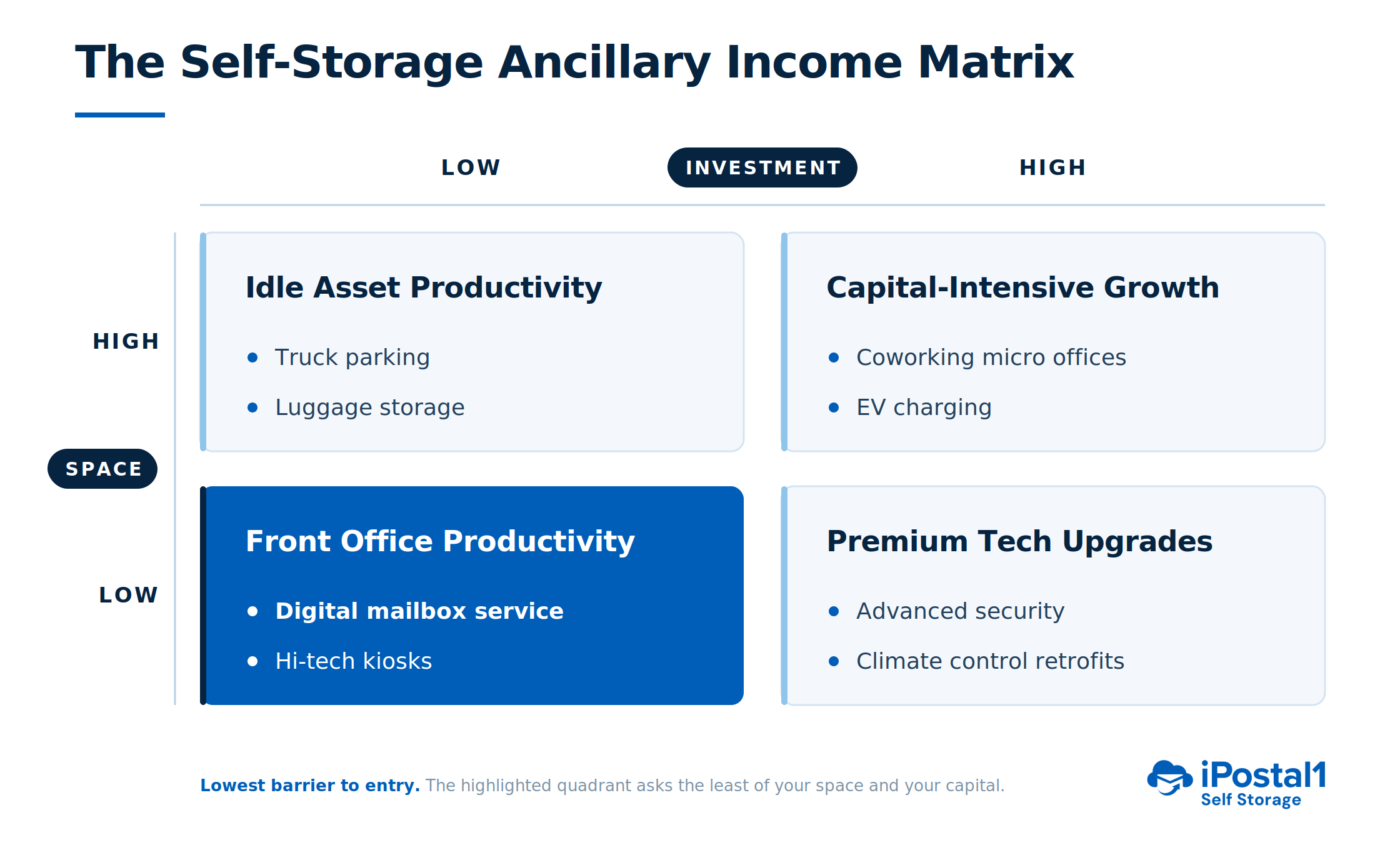
If you are feeling a little overwhelmed by the number of new ancillary income opportunities suddenly available, it helps to have a framework to sort and evaluate which are the best fit for your business. We’ve created an Ancillary Income Matrix for self-storage operators that does just that.
Whether driven by new digital platforms (security upgrades, digital mailbox, truck parking) or not (self-serve kiosks, coworking micro offices), the sooner you move ahead, the sooner you start building incremental cash flow and increasing NOI. When you look at a new service, four questions come up:
How much money can I make?
How much work does it take?
How much space do I need?
How much investment is required?
A service that pays well without much work looks attractive. But if it costs more than you're ready to spend or takes more space than you have, it isn't a fit.
The matrix below sorts opportunities by space and investment, the two constraints that rule options in or out fastest.
Services in the lower left ‘Front Office Productivity’ quadrant ask the least on both counts, and services in the upper right ‘Capital-Intensive Growth’ quadrant ask the most.
The ‘Idle Asset Productivity’ quadrant covers high space and low investment, and the ‘Premium Tech Upgrades’ quadrant covers low space and high investment.
Front office productivity: Low Space, low Investment
If you staff your facility, the biggest opportunity is pulling more revenue from the labor and front office square footage you already pay for. Packing materials, locks, and tenant insurance have been part of that playbook for years. Recurring subscription revenue from digital platforms is the new layer.
Digital mailbox service
iPostal1 needs a file cabinet and about 30 minutes of labor per day for every 100 customers who sign up at iPostal1.com and choose your address for business or personal use. Your staff can handle the work during downtime.
You receive mail and packages on the customer's behalf, then use the iPostal1 Admin app to send notifications and complete the tasks they request, whether that's forwarding, scanning contents, shredding, or discarding. Local customers pick up in person, which brings foot traffic and upsell opportunities.
You earn a revenue share on the monthly mailbox subscription and on every task you perform.
We handle the marketing, sign up the customers, and manage the transactions.
iPostal1 has paid more than $150 million to mail center partners, who earn about $10 per customer per month.
You can also offer the service to your own renters, many of whom are mid-transition and need a secure place to receive mail and packages.
Hi-tech kiosks
KeyMe kiosks duplicate keys and fobs automatically. Each one occupies nine square feet and draws non-tenant visitors past your retail displays, and you collect a share of the revenue.
Bitcoin ATMs reach cash-based customers.
In both cases, the provider handles hardware, compliance, and cash logistics, and you take either flat monthly rent of $200 to $600 or a percentage of transaction fees.
Service referral programs
These sit outside the matrix because they ask nothing of your space or your capital. Muvr pays up to 10 percent commission per booking on moving labor and junk removal referrals, and its top storage partners earn more than $2,000 a month.
Unpakt and Your Hometown Mover pay commissions of up to 5 percent on linehaul charges for local and long-distance moves that start from a web link or QR code you provide.
Idle asset productivity: High space, low Investment
Put idle space to productive use by tapping into turn-key programs provided by digital platform vendors that handle the marketing and transactions.
Truck Parking Club connects commercial drivers with secure parking. Only one legal parking space exists for every eleven trucks on the road, and that shortage lets you earn on wide drive aisles, dead-end corners, or surplus perimeter pavement.
Sign-up is free, and the platform runs 24/7 customer support, digital marketing, signage, and Stripe payment processing.
Ten tractor-trailor stalls at $30 a night would yield $4,500 in gross monthly revenue at 50% occupancy, with your share depending on the vendor’s take.
You keep full control through a dashboard, so you can toggle availability and black-out dates for seasonal overflow or maintenance.
Short-term luggage storage
Bounce runs a luggage storage and package acceptance network across more than 4,000 cities. If your facility sits near a transit hub or an urban tourist core, you can operate as a store-in-store partner.
Your staff check bags in and out through a cashless app using digital records and tags, backed by up to $10,000 in bag protection coverage.
You can serve as a Service Spot and earn storage fees directly, or join as an Affiliate Partner and earn 10 percent commission for referring local travelers through your own link.
Capital-intensive growth: High space, high Investment
If you have excess space or space to repurpose, capital to invest, and a higher appetite for risk/reward, opportunities in this quadrant could work for you.
Coworking micro offices
Converting excess office space or large underperforming units into micro-offices or small coworking suites can command much higher rent per square foot than storage.
The build costs money:
Demising walls
Upgraded lighting
HVAC adjustments
Better security
High-speed Wi-Fi
Conference rooms
Shared break areas
This works best in urban infill markets and near concentrations of remote workers and creative professionals. In those markets, digital mailboxes and coworking feed each other, because entrepreneurs start with a virtual address and graduate into a micro-office in the same building.
EV charging stations
You install Level 2 or DC fast chargers in parking stalls and resell electricity to drivers, charging per use, by subscription, or through a mix of the two. A fast charger can generate $1,680 to $4,200 in monthly gross revenue.
Capital costs run high, though state zero-emission infrastructure grants and utility rebates often cover part of the bill.
Charging pairs well with facilities that have underused parking and sit near multifamily housing with limited dedicated parking.
Drivers stay on site for thirty minutes or more, which gives you a window to market storage to them.
Premium Tech Upgrades: Low Space, High Investment
Premium Tech Upgrades names the axis split directly, since it's the least intuitive quadrant. It also sets up the two revenue mechanics the vendors then illustrate: a fee on top of rent, or a higher rate on the unit. That ties into the NOI math in your closing section.
Advanced security
In-unit monitoring is one of the fastest-growing features tenants will pay extra for, which turns security from a cost you absorb into a service that earns.
StorageDefender runs 24/7 monitoring for motion, temperature, and humidity with real-time text alerts to tenants, and it integrates with property management software to automate tenant onboarding and billing. The standard subscription averages $12 per unit per month.
Installation costs little in labor, because the wireless, magnetic-backed devices attach inside units without wiring or power outlets.
You can pay for the hardware over time on a pay-as-you-grow basis. Optional hallway and common-area sensors connect to the unit monitors to cover the whole property.
Climate control retrofits
Retrofitting units with climate control typically costs $35 to $70 per square foot, covering:
HVAC installation
Insulation
Electrical upgrades
Ductwork
Vents
Climate control raises rental rates by 20 to 40 percent and attracts year-round renters who want protection for wood furniture, electronics, and paperwork.
Higher rates, steadier occupancy, and year-round demand all push property value up.
Where to start with ancillary income products for your self-storage facility
Don't let the range of options stall you. Use the matrix to find the opportunities that fit the space and capital you have, then pick one to start with.
Operations teams sometimes resist new services as a distraction from maintaining the facility and taking care of customers, but leadership has to make the case that the revenue produced and incremental NOI generated are worth the effort.
At a 6 percent cap rate, an extra $1,000 a month in NOI adds $200,000 to the value of your property.
Add the customer satisfaction, loyalty, and lifetime value that come with these services, and the case gets stronger still.
To learn more about the services covered here and other ancillary revenue opportunities, download The Ancillary Advantage, a free white paper on unique revenue streams for Self-Storage operators.
If you’re ready to start building a new ancillary revenue stream for your self-storage business, contact us today.